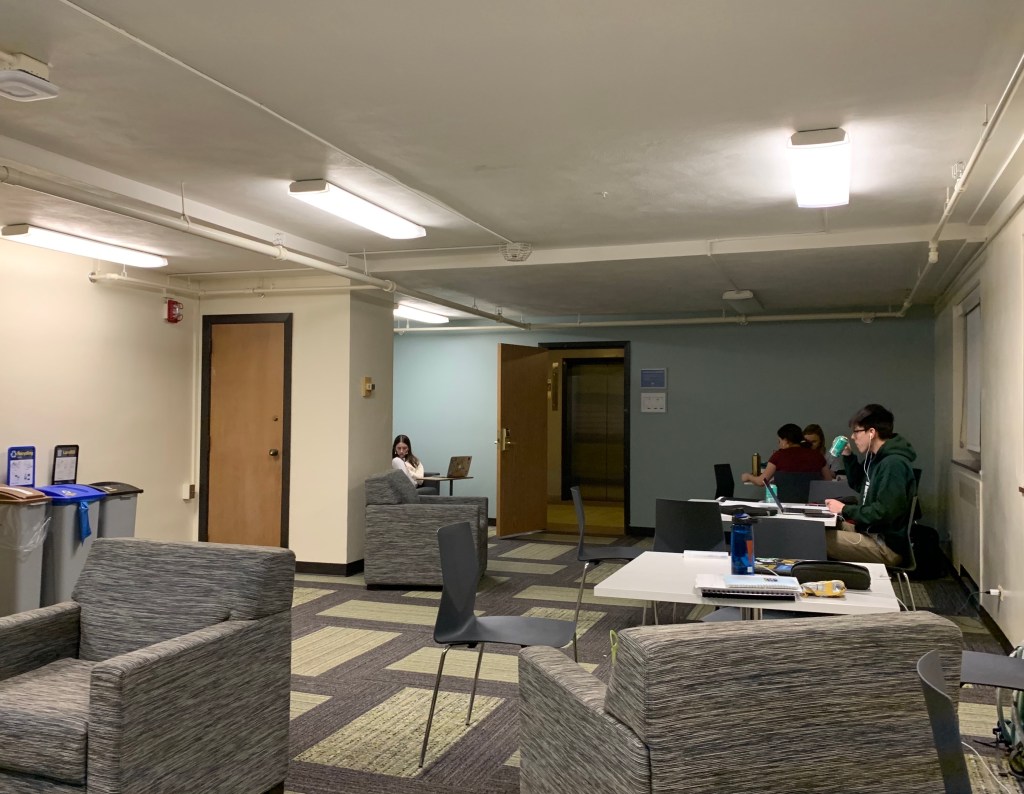
I took my domain picture in the dorm lounge on our floor. People often use this domain to do their homework and relax after classes. For the most part, only our hall uses it even though the door is open and anyone can walk in. Even more surprising is that not all halls have a lounge, meaning that theoretically there should be even more of an incentive for people from other floors to come use our lounge. However, there is a sense of identity that is associated with ones dorm hall, and that is expressed through the name of the hall right outside our lounge. The name outside is able to deter people from entering the lounge because they don’t feel it’s theirs to use. I’m facing the east door of the domain, and what I can see are chairs, couches, and tables all thoughtfully arranged to encourage a collaborative environment while also prioritizing comfort in the way and material in which the furniture is built. However, there is a sharp contrast between the soft, rounded edges of the fluffy chairs, and the hard, sharp geometry of the plastic chairs. Rasmussen writes, “When we see a spherical object we do not simply note its spherical shape. While observing it we seem to pass our hands over it in order to experience its various characteristics.” (18) While the room has strict boundaries that are clearly defined as walls, the interior of the room also has boundaries and domains that are not as clear. For example, the domain in which the man in the green sweatshirt demands is much larger than the domain of each of the women pictured behind him. The personal domain is more of a product of culture and comfortability, and the room tries to tighten some of those domains by forcing people to decrease proximity to each other at tables. However, this ideal is somewhat broken down because we can see through the picture that the man in the green sweatshirt is sitting alone at a table designed for 4, and it is unlikely that a stranger will enter his domain for fear of being nosy or not polite. This idea relates to Levine’s writing as he says, “Human creations transform this natural world to accommodate the needs and desires of human beings.” (35) The human creation of the lounge was meant as a leisure space so students who desired a low volume space could be satisfied.
 Brian's 212 Understanding Architecture Section