REVIEW: Design remains at the center of all architectural education, as it has for over a century. Given the world and its issues have changed since the late 19th Century, I believe this form of education is outdated. I believe design and studio should be a cornerstone of the education, as any architect must understand form to convey their message, but it should not be the main focus. The architect need only know how to design and express their ideas, which can be accomplished with a less intense focus on the topic. By prioritizing an aspect of the field that is really just part of modern architecture, I argue that students become distracted from what should be accomplished with architecture in today’s society. The core of what architecture should accomplish is change, which can only be achieved by understanding and valuing the issues we face. With that, our world in the 21st century pivots at the drop of a hat. With the dawn of technology, new issues arise every day, each requiring different attention and solutions. As a result, I believe more emphasis should be placed on the schooling of contemporary issues. In order to best understand the issues of today and tomorrow, we must understand the issues of just yesterday, and today, more so than the issues of 100 years ago. McDonough flashed a bright light on this concept through the lens of ecology. Humanity’s greatest problem today is in the form of natural destruction, at the hands of an overly industrialized and consumer-based society. In order to best attack these issues, architecture schooling should expose how sustainability has been forgotten in past architecture as much as it has in industrialized society. Conversely, emphasis should be placed on a new form of architecture that strives to be entirely sustainable. While this won’t be achieved immediately, the only way to reach this goal is to equip students with the knowledge and initiative to attack it step by step. For them to truly realize how deeply engrained these issues are, the field should be more self-critical in order to truly change, because there are countless structures existing today that entirely defy our definition of sustainability. Furthermore, it should be stressed that there are ways to improve the sustainability of these very structures as well. New designs and ideas are discovered frequently to improve within this issue, so students should be taught in real time on these topics so as to best utilize them for a better tomorrow.
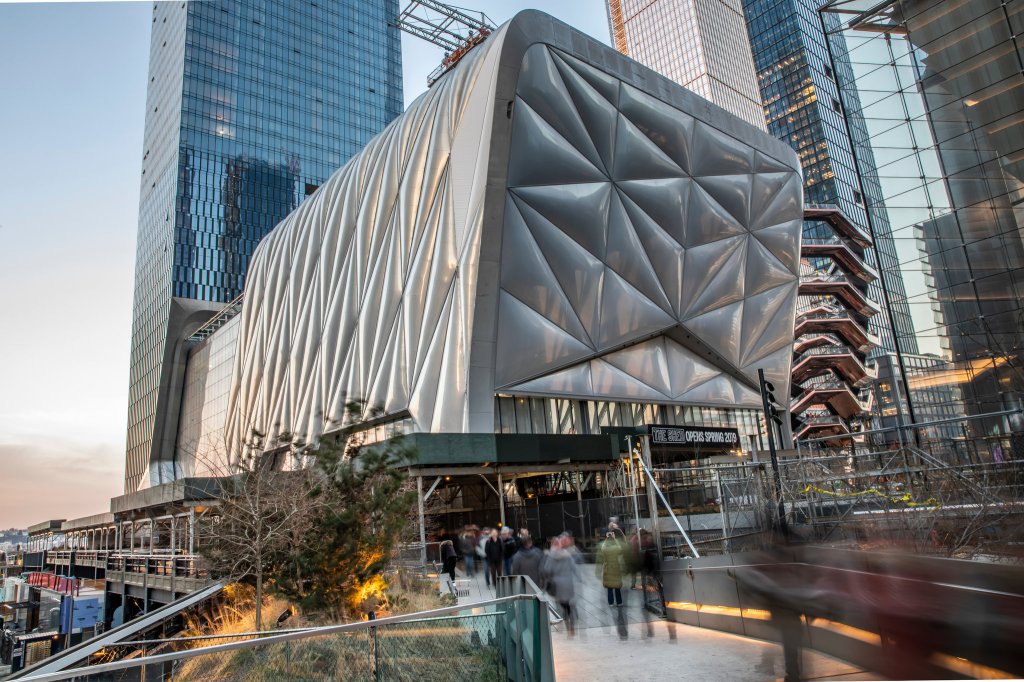
DOCUMENT: The building I chose to analyze was The Shed in New York City. The designers of this building sought to create an adaptable space for the use of artists for the foreseeable future. Its moveable exterior allows for adaptability in scale, and its open spaces provide a limitless scope of uses. To design this building and its moveable stage, extensive education in courses such as Mechanical Systems, Electrical Systems, and Structures were necessary. Reinforced Concrete and Continuous Structure is also needed for the design of the shell, as it is a seemingly continuous piece of material. Furthermore, its aim to pay homage to the Industrial roots of the area suggest an education in a History of Architecture course. The nature of the building as a progressive space implies schooling in Sustainable Design, and its focus towards the performing arts implies a need for education on Acoustic Systems. In order to design such a complex space, CAD in Practice would also be necessary.
INVENT: The course I would create is a Modern Problems in Architecture course, in which the professor would present new, breaking topics and designs in architecture. All topics would need to be on architecture problems and points of emphasis from the year 2000 and beyond. Furthermore, the professor would incorporate cutting edge design solutions into the core information, such as designs created to combat pollution. These examples of new innovation should serve as inspiration for students to see how architects are confronting issues that they can see in their everyday lives. It may also serve to show students how much more change is necessary to truly resolve these issues. This would serve as a course similar to a history in architecture yet be entirely contemporary so as to thoroughly educate students on the climate of current architecture.
 Brian's 212 Understanding Architecture Section