There are thousands of living spaces in Ann Arbor. Some are big, some are small. Some prioritize luxury, while others are just a roof. No matter the space, Ann Arbor landlords have had no problem finding suitable residents for their property, that is until 1006 Woodlawn Ave surfaced on the market.
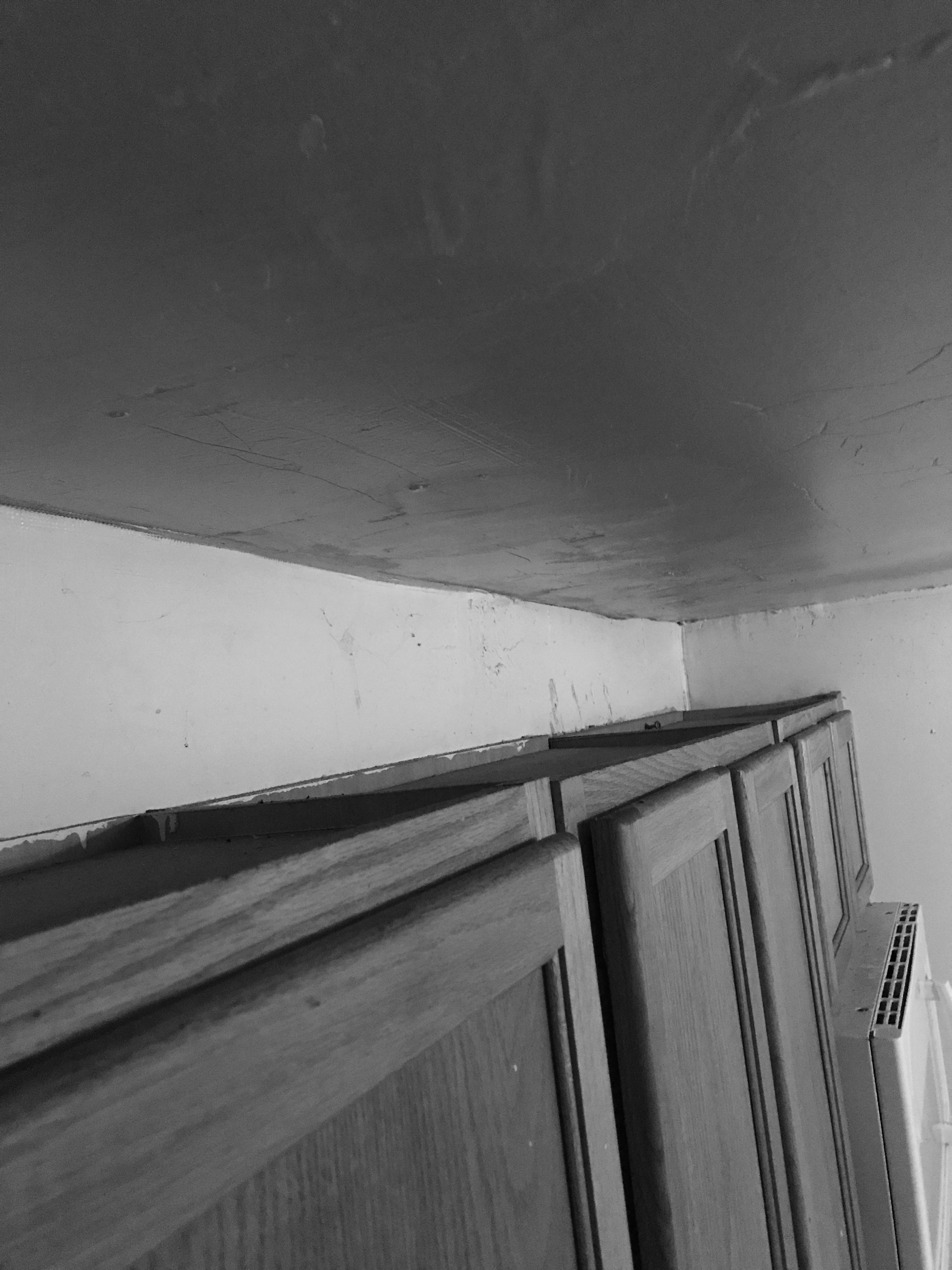
After its most recent resident was convicted and the crime scene at the house had been closed, the house began to circulate the market and struggled to find any occupants. The house was constructed by the owner himself, who had built many ledges and lips to display the products and of his horrific anatomical experiments.
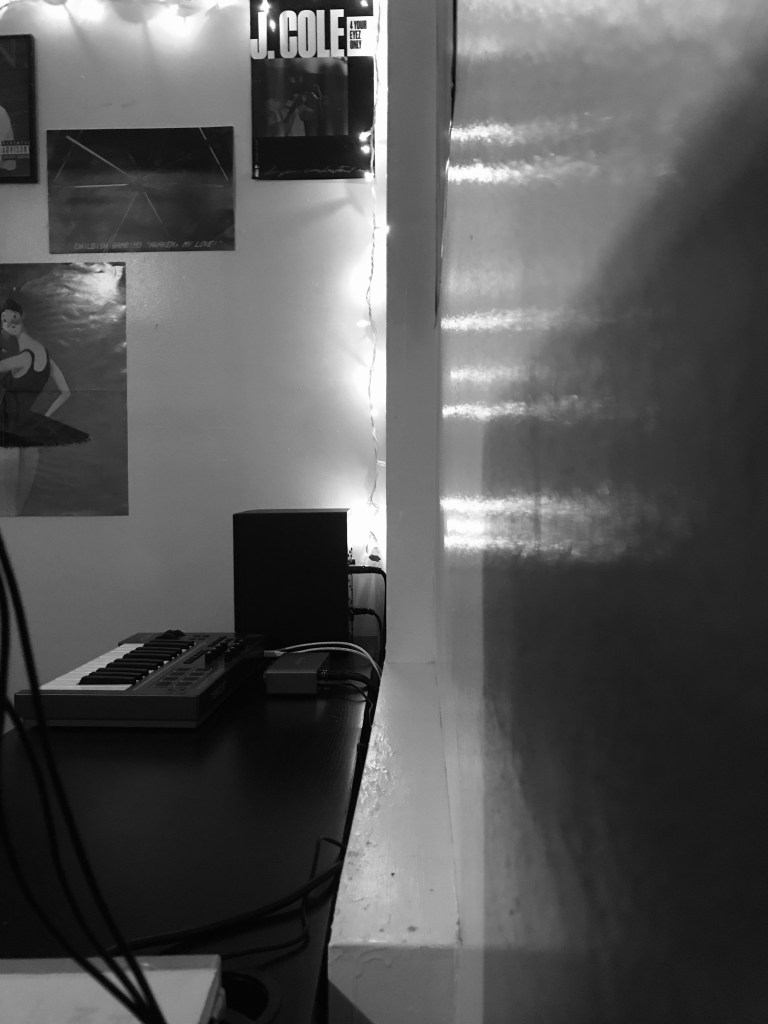
Then along came Steven, a full time musician who has spent the majority of his twenties couch surfing between gigs. Seeing its forgiving price tag, Steven came to tour the space. Finding all of the rigid and obtrusive ledges as practical for all of his musical equipment, he jumped at the opportunity to sign the lease. Upon moving in, he filled the spaces with as many cables, drums, guitars, microphone stands, and amplifiers as possible. The space allowed him to prioritize his passion for music at little to no cost.
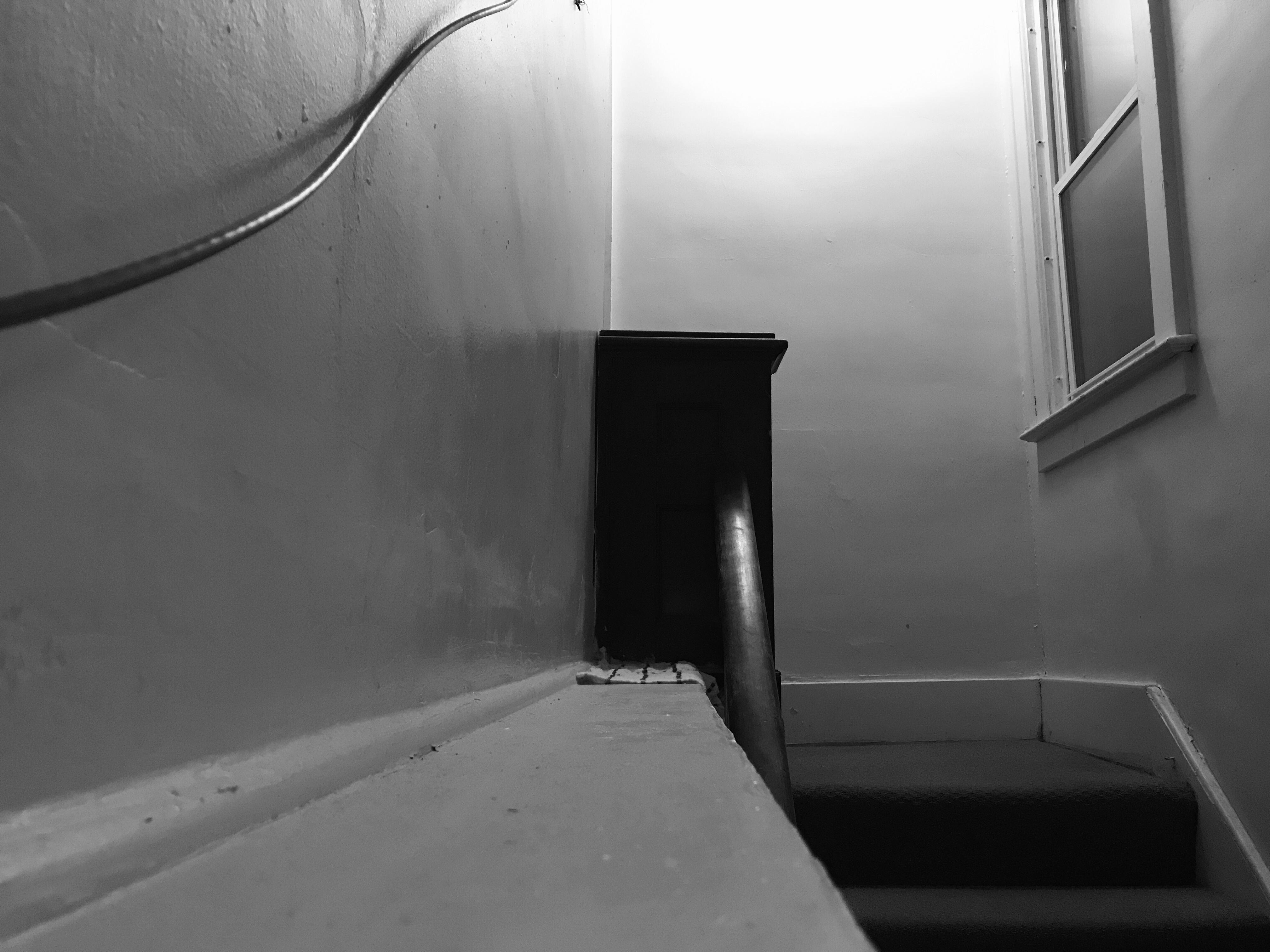
His only complaint was a strange noise reaching up the stairs from the basement in the dead of the night. One night, he struggled so much to fall asleep that his curiosity got the better of him, and he explored the unnerving basement for the first time. He had a gig booked for the next day, and upon his absence and lack of contact, his bandmates arrived at 1006 only to discover the front door wide open, without a trace of their dear friend.
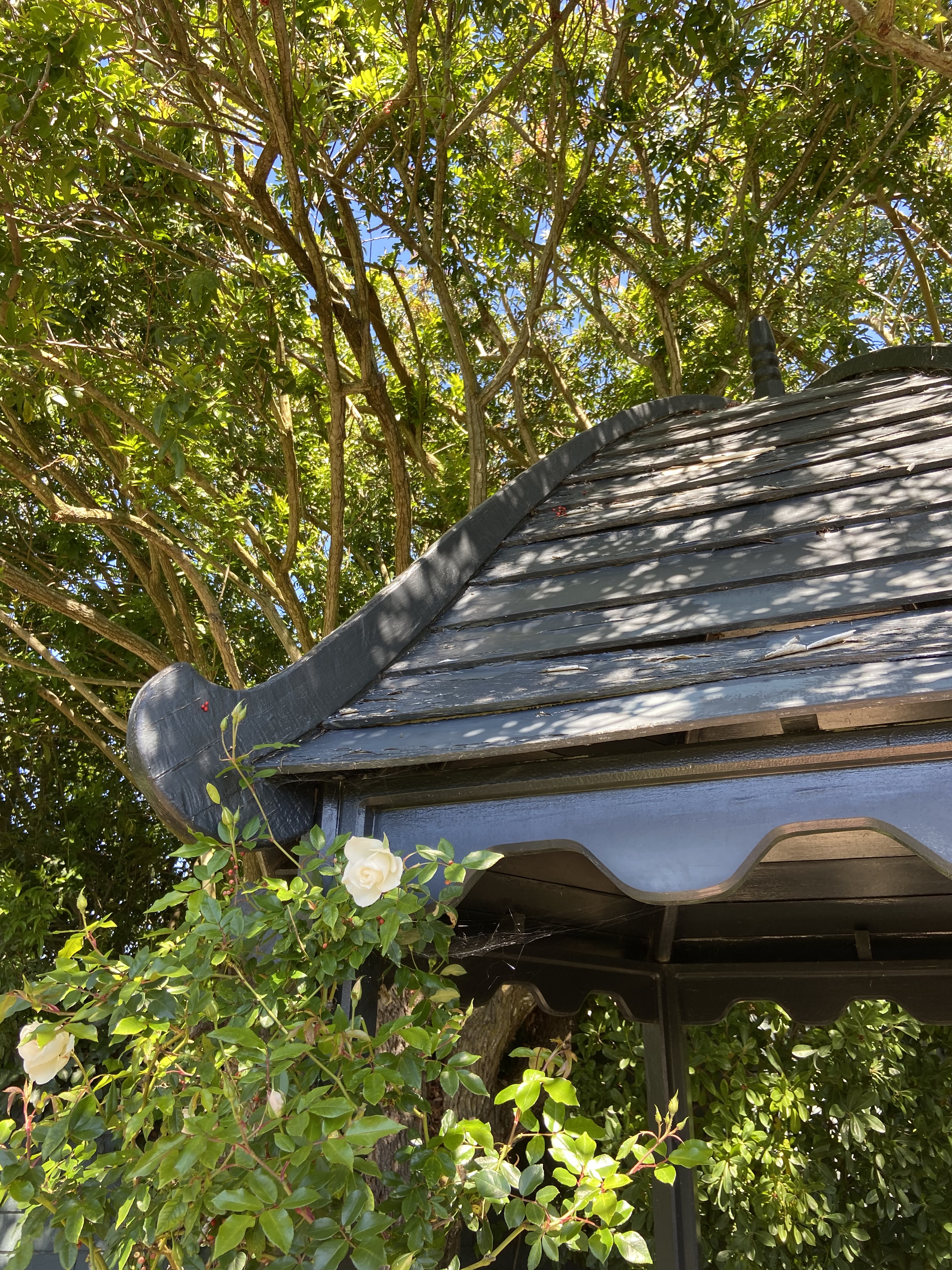
As a structure of protection and cover from outside elements the detail of the roofs slope pushes rain or debris away from those underneath. Not only is the structure covering the head of whoever inhabits it but it also pushes any unwanted falling matter away from the individual. The structure acts as a protector and counteracting force.
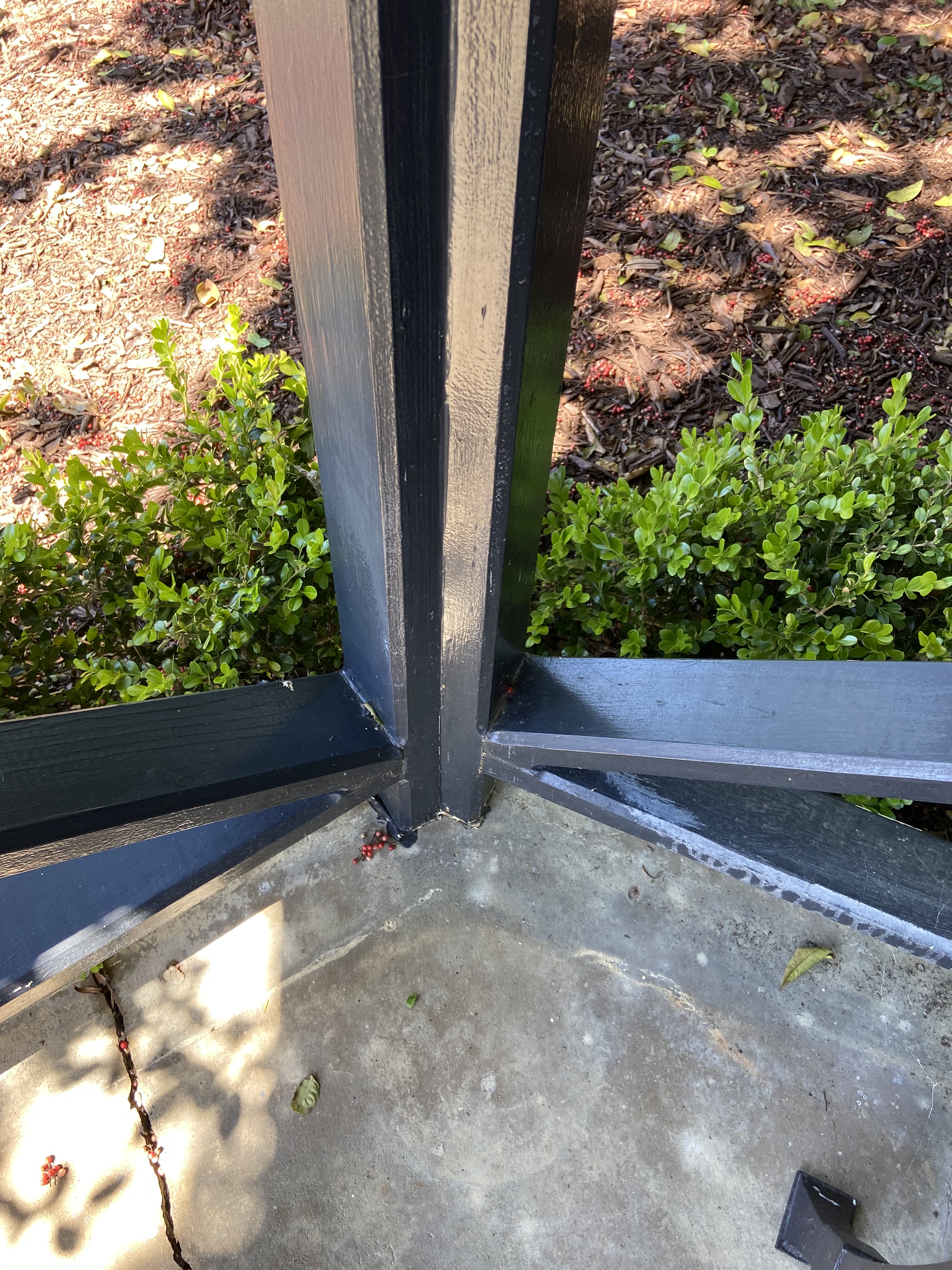
The wood at each corner opens its arms to the individual inhabiting the structure. The detailed corner allows the structure to curve in a circle while also welcoming those inside and symbolizing a warm sense of welcoming and belonging.
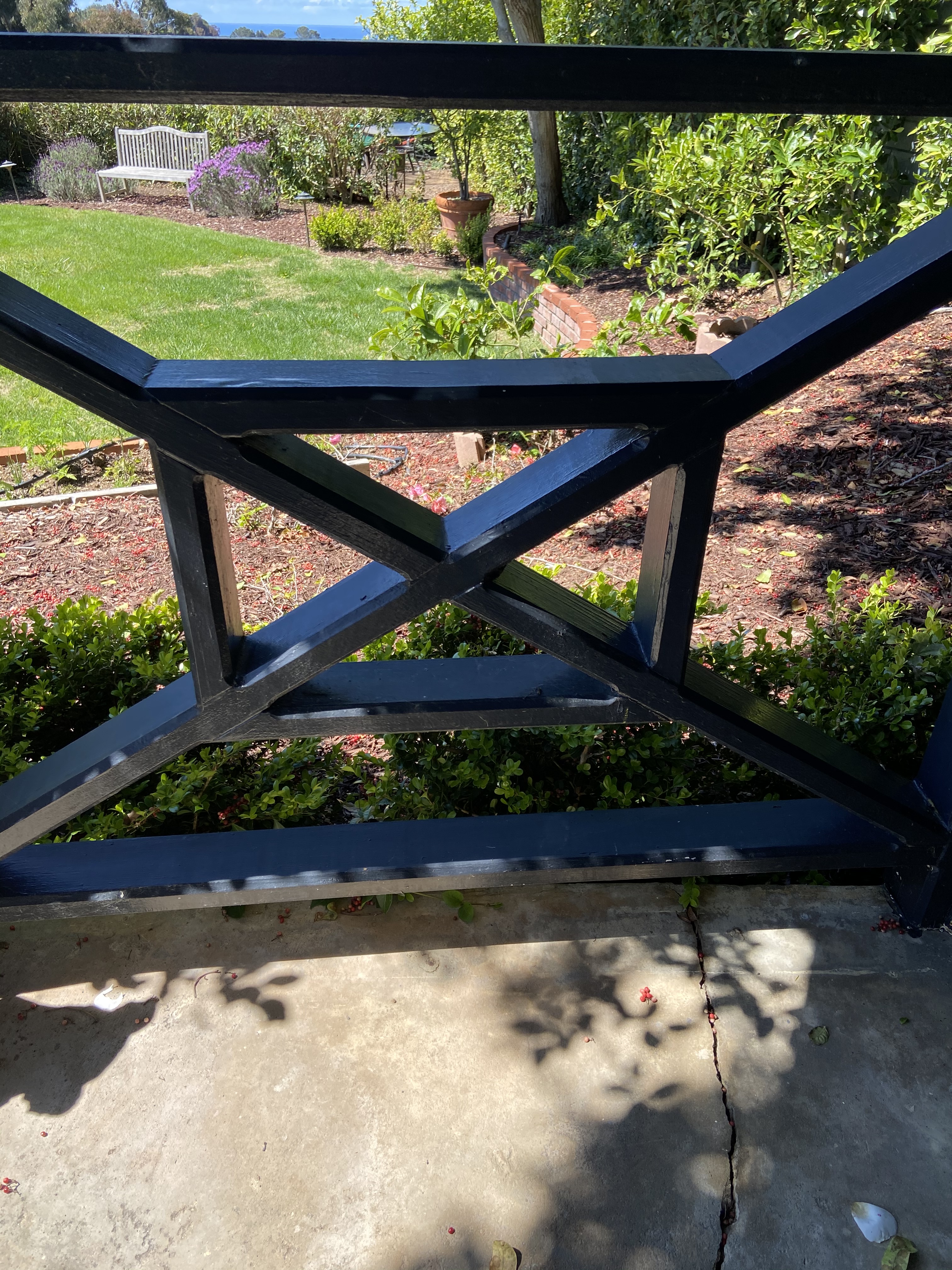
The crosshatching fence provides protection and ensures that there is only one way in and one way out of the structure. The criss-cross and the box provide aesthetic appeal while also limiting the ability of an intruder to enter the structure.
The combination of these three details provide a safe and welcome atmosphere for the inhabitant. They can be assured that not only will unwelcome intruders be stopped but in the case of the roof, pushed further away. The details provide both an aesthetic and functional purpose that makes the structure a comfortable place to rest in all conditions.
REVIEW: Design remains at the center of all architectural education, as it has for over a century. Given the world and its issues have changed since the late 19th Century, I believe this form of education is outdated. I believe design and studio should be a cornerstone of the education, as any architect must understand form to convey their message, but it should not be the main focus. The architect need only know how to design and express their ideas, which can be accomplished with a less intense focus on the topic. By prioritizing an aspect of the field that is really just part of modern architecture, I argue that students become distracted from what should be accomplished with architecture in today’s society. The core of what architecture should accomplish is change, which can only be achieved by understanding and valuing the issues we face. With that, our world in the 21st century pivots at the drop of a hat. With the dawn of technology, new issues arise every day, each requiring different attention and solutions. As a result, I believe more emphasis should be placed on the schooling of contemporary issues. In order to best understand the issues of today and tomorrow, we must understand the issues of just yesterday, and today, more so than the issues of 100 years ago. McDonough flashed a bright light on this concept through the lens of ecology. Humanity’s greatest problem today is in the form of natural destruction, at the hands of an overly industrialized and consumer-based society. In order to best attack these issues, architecture schooling should expose how sustainability has been forgotten in past architecture as much as it has in industrialized society. Conversely, emphasis should be placed on a new form of architecture that strives to be entirely sustainable. While this won’t be achieved immediately, the only way to reach this goal is to equip students with the knowledge and initiative to attack it step by step. For them to truly realize how deeply engrained these issues are, the field should be more self-critical in order to truly change, because there are countless structures existing today that entirely defy our definition of sustainability. Furthermore, it should be stressed that there are ways to improve the sustainability of these very structures as well. New designs and ideas are discovered frequently to improve within this issue, so students should be taught in real time on these topics so as to best utilize them for a better tomorrow.
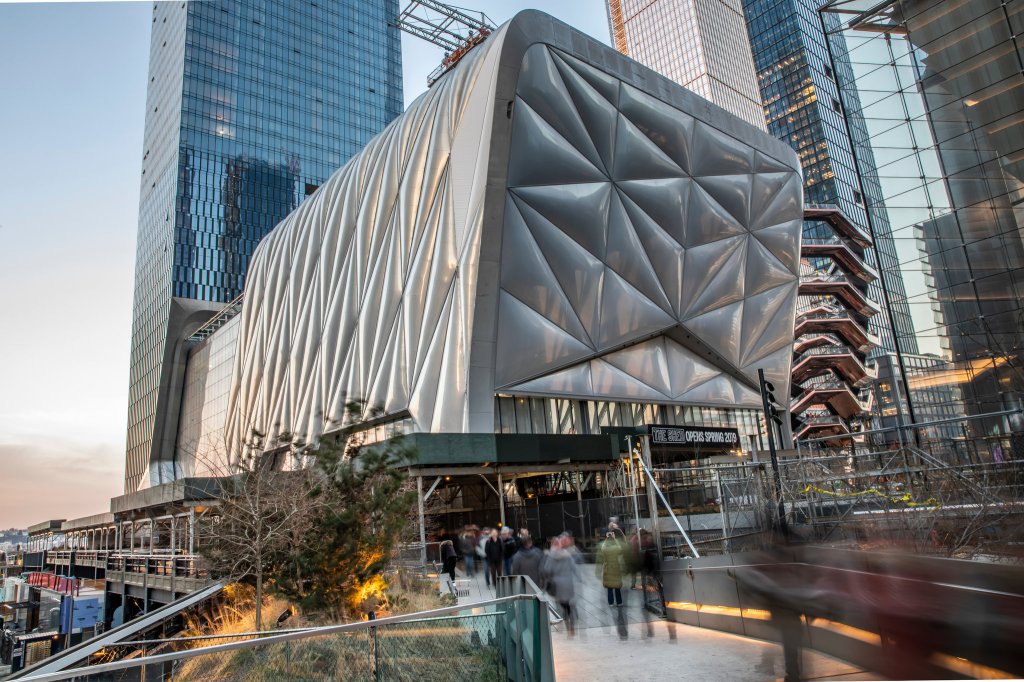
The Shed
DOCUMENT: The building I chose to analyze was The Shed in New York City. The designers of this building sought to create an adaptable space for the use of artists for the foreseeable future. Its moveable exterior allows for adaptability in scale, and its open spaces provide a limitless scope of uses. To design this building and its moveable stage, extensive education in courses such as Mechanical Systems, Electrical Systems, and Structures were necessary. Reinforced Concrete and Continuous Structure is also needed for the design of the shell, as it is a seemingly continuous piece of material. Furthermore, its aim to pay homage to the Industrial roots of the area suggest an education in a History of Architecture course. The nature of the building as a progressive space implies schooling in Sustainable Design, and its focus towards the performing arts implies a need for education on Acoustic Systems. In order to design such a complex space, CAD in Practice would also be necessary.
INVENT: The course I would create is a Modern Problems in Architecture course, in which the professor would present new, breaking topics and designs in architecture. All topics would need to be on architecture problems and points of emphasis from the year 2000 and beyond. Furthermore, the professor would incorporate cutting edge design solutions into the core information, such as designs created to combat pollution. These examples of new innovation should serve as inspiration for students to see how architects are confronting issues that they can see in their everyday lives. It may also serve to show students how much more change is necessary to truly resolve these issues. This would serve as a course similar to a history in architecture yet be entirely contemporary so as to thoroughly educate students on the climate of current architecture.
1.) Design studio is widely thought to be at the center of architectural education. Is this true in our times? Should it be?Studio time seems to be the most important aspect of an architecture student’s career, and that is certainly true for UofM’s architecture degree. I agree with the fact that it should be the center of education because it is my personal philosophy that quantity of work teaches craftmanship and ideation skills over one or two quality works.
2.) What skills does an architect need to acquire in order to conceptualize, coordinate and execute an architectural project today? Some skills that an architect must acquire is to be able to do research. What has been done before and what does the space need in terms of architecture. After that, design skills followed by the ability to communicate with businessman, engineers, and a construction team.
3.) What (other) fields of study might be included in the architect’s contemporary education? Some other fields of study that might be included in an architect’s education might be psychology, business, material studies, and theory/philosophy.
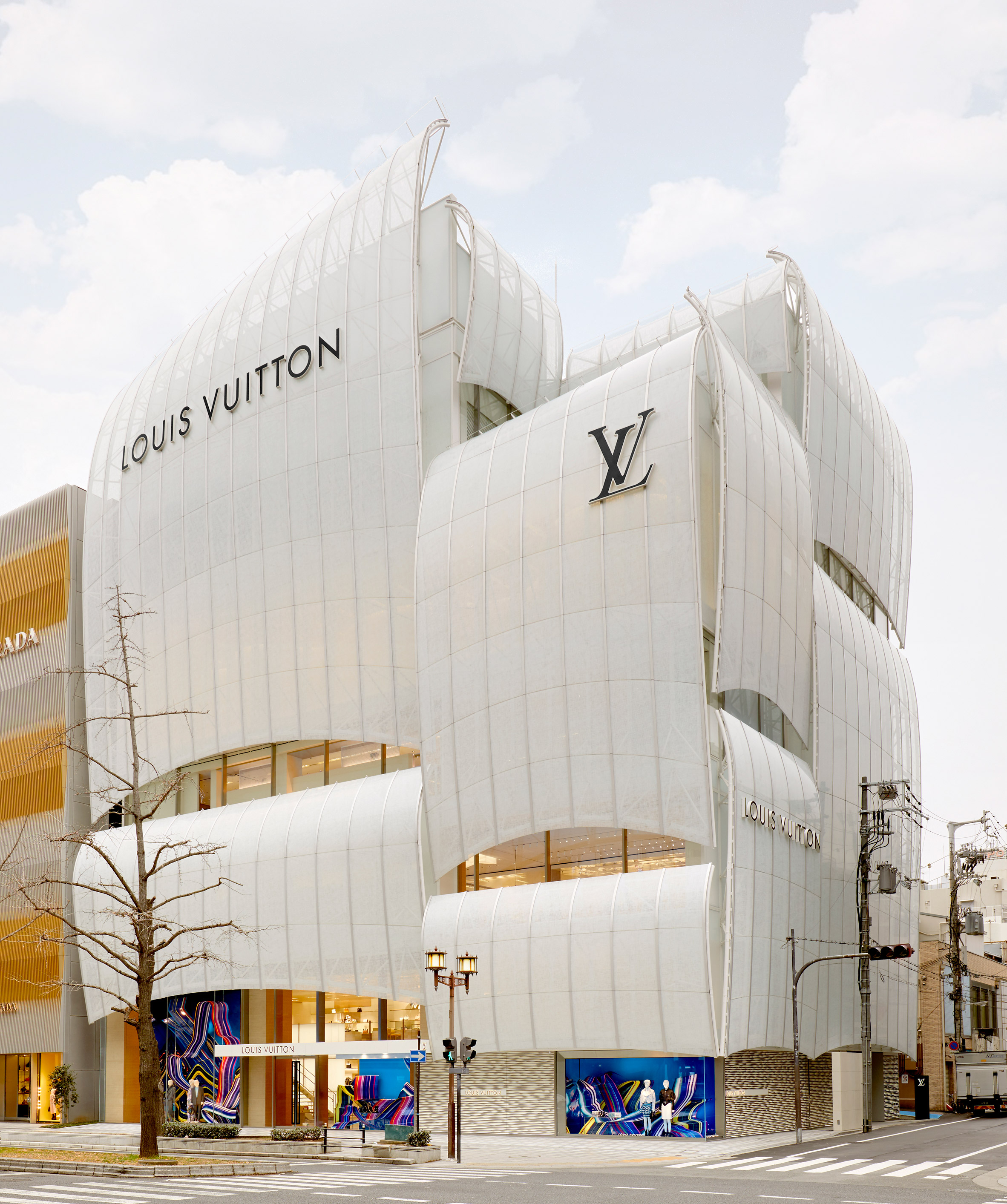
Louis Vuitton Storefront in Osaka designed by Jun Aoki & Associates and Peter Marino.
Document
8 perceived fields of study necessary to successfully conceive the building above:
1.) Mythology – Mythology because the shape of the building inspires wonder and delight and the ‘billowing’ glass sales seem to reflect imagery from famous mythology.
2.) Material Studies – It’s important to learn about different materials that can be used during construction that will help realize the vision of the architect.
3.) Engineering/Physics – An understanding of curves and weight distribution is apparent.
4.) Environmental Systems – Understanding how the environment affects the building but also how the building affects the environment.
5.) Real Estate Design and Development – Understanding how commercial buildings are designed and built.
6.) Construction – Helps with understanding construction vocabulary and communication.
7.) Architectural Theory – A historical understanding of other buildings and the ability to reference those ideas and concepts.
8.) Structural Concepts – Same with material studies, learning how different structures can help realize the vision of the architect.
Invent
New Course: Change by Design
Over the course of a semester, students will learn different theories and computational programs to help them connect to different communities and cultures. The first half of the semester will be learning in the classroom with the second half focusing on real-world implementation. Students will have the opportunity to collaborate with a local design firm working with different cultural groups to build engaging community centers.
The appeal of this course would be to engage students in a design process for people and communities that they may not personally belong to. This course will go on to teach design thinking and empathy as well as creating a tool kit on how to approach projects for different cultural and heritage groups. The class itself will structure itself as a design firm with groups of students taking up certain roles. By the end of the class, each student will have an understanding on what it takes to bring an architectural drawing to reality regardless of whether or not their project was successful. This would be a studio course.
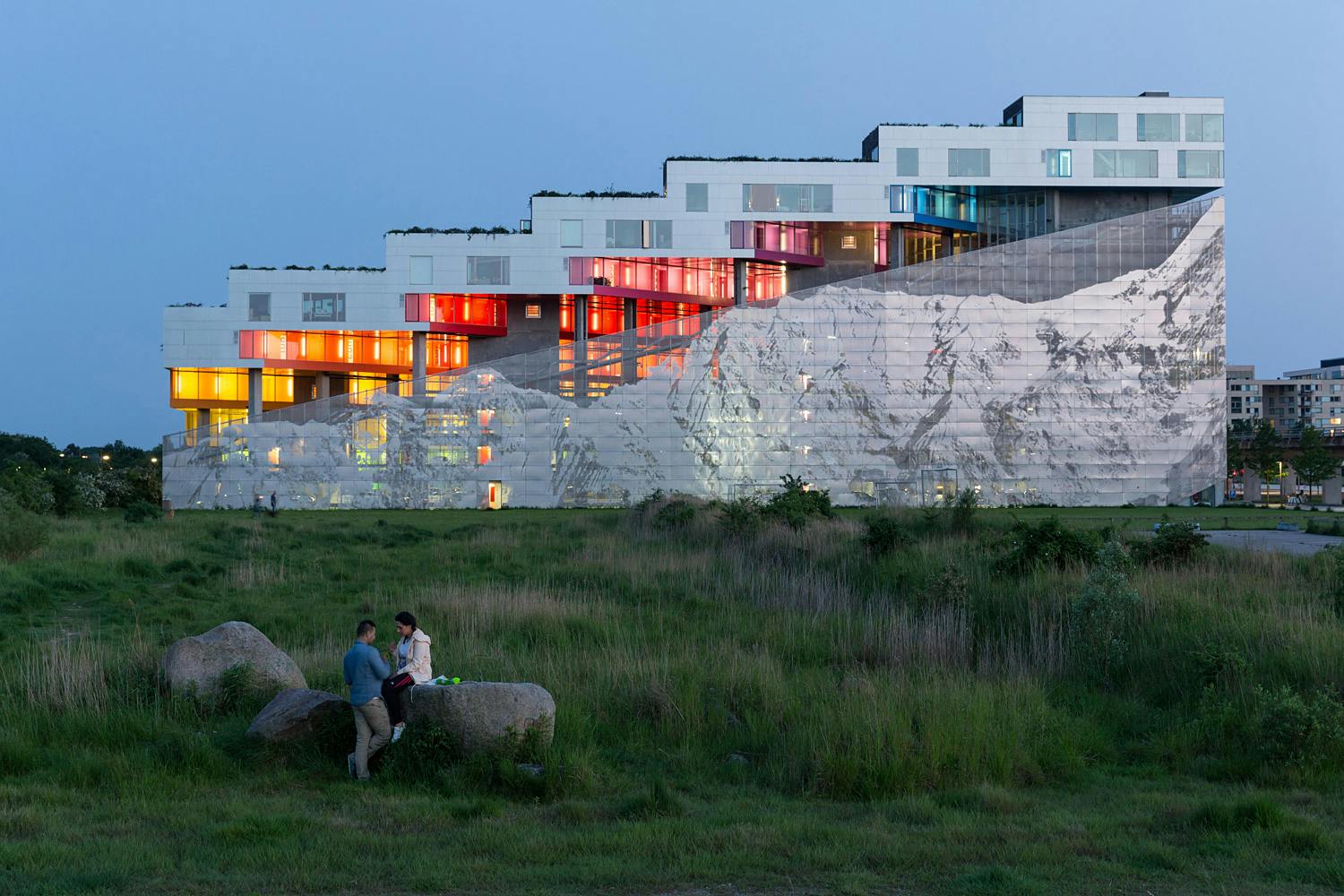
For my building, I chose The Mountain which is an apartment building designed by Bjarke Ingels. Apart from the professional design of the building, many other professional techniques were used to comprehend and construct the building. Some of the fields of study I think were necessary in the entire process of conceiving and constructing this building are computer science, environmental science, materials science, structural physics, advanced geometry, anthropology, business relations, and basic industrial construction. These different fields of study are all necessary to be able to create a building from start to finish. While architecture focuses mainly on the design of the building, these other fields can be just as important to architects, as they have to design the building around other principles rather than just aesthetics. These different fields (some of which are required for a proper education in architecture) help provide a more well rounded curriculum for architects to be able to understand what they are designing.
The Mountain
I think that an environmental structures course within the architecture curriculum would be extremely beneficial especially for modern architects to be environmentally conscious through joining the natural world and the artificial world in which we create buildings and infrastructure. With climate change becoming more and more of a world problem. Architects need to be able to adapt to a changing world while also preserving some of the traditional values in architecture such as space and structure. The course would mainly consist of looking at how different organisms are able to build structures as well as how we can limit the ecological impact of those structures. Additionally, the course should look at the aesthetics of nature and how that can be integrated into modern architecture.
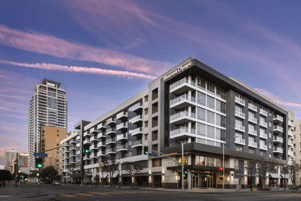
Hanover Olympic building, Los Angeles, by TCA Architects
1. Sustainable Materials– the Hanover development group makes it a goal to create sustainably designed structures. For this building they used recycled glass and reclaimed wood. They also put solar panels on the building. 2. Urban Planning– I think this class would be essential when building housing. This building is L.A’s first “net zero” residential space. 3. Sociology – learning about the need for environmentally sounding housing closely ties to sociology and keeping up with how our society is adapting to climate change. 4. Structural Concepts- I think it is critical to be able to understand why a building stands and how to create it in the most efficient way. 5. Physics- Critical to be able to understand how a structure functions and how to create a safe space. 6. Building Technology- This design seems to integrate a lot of modern technology. This building utilizes solar power and sends power back to the cities utility grid. 7. Digital Drawing- As buildings become more and more inventive and use renewable products I think it would be important for architects to use digital drawing as a way to ideate and experiment before the actual product is built. 8. Architecture History/ Theory – critical for understanding the origins of architecture and how they are still influencing us today.
New course: Design for Change
This course would be for upper level undergraduate architecture students. It would challenge them to, over the course of a semester, design and create a model of a space that would fulfill a need within their community. This class would teach ideation, design, and building skills. The students would work in groups of four.
The students would go out into the community to explore areas that could use an architectural upgrade that would benefit the local population. The architectural program would collaborate with specific community areas such as homeless centers and health clinics that are in need of changes to their building to improve functionality. The class would be set up as a sort of competition, the best design would be built and integrated into the community. The students would base their design off of the specific needs of the people that utilize the space.
The purpose of this class would be to benefit the community through design while simultaneously teaching students how to: collaborate with an organization, learn professional practice, and see the process of ideation and design to a final product.
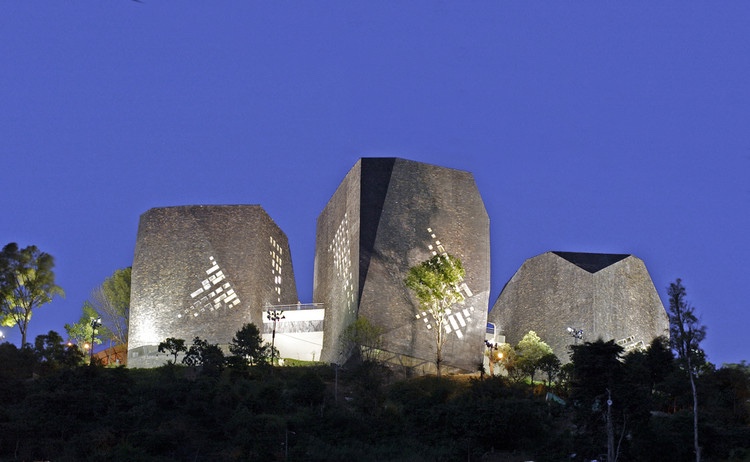
This is the Biblioteca Parque España by Giancarlo Mazzanti in Santo Domingo, Columbia.This building is a library and also serves as a public transportation center, employment recourse center, auditorium, and recreational space. The library is in a dangerous and impoverished area of Columbia, and since its construction it has improved the surrounding areas by providing educational and recreational recourses to nearby residents, bringing tourism, and providing a cable-car system in an area with a significant incline.
In order to create a building like this, here are some of the necessary areas of study I can hypothesize-
Social Impact/Social Change- this building was constructed as a means of social and economic improvement in this area.
Transportation- this building has a cable car system, and transportation center which not only transports people to and from the building itself, but also up and down the terrain.
Lighting Design for architecture- the exterior lighting design of the library is important to the design as a whole because it is illuminated through the windows, and through projected light upwards from the ground.
Columbian/Latin American History- I think it is important to understand the history of the city, country, surrounding area, and region as a whole in order to create a functional building that serves the area well, and also takes into account the influences of the region.
Infrastructure for Public Spaces- this is a public building that serves many purposes, and is also free to access. It serves ordinary people, and people of all ages and social statuses. I think the range of uses for this building was definitely taken into account. Also, constructing and designing a public space im sure is different than creating a private space.
Tourism- This building is a tourist attraction that brings commerce to the area.
Stonework- This skill was probably not as necessary for the designer as it was for the contractor and builders, but the building appears to be straight black, but in reality it is a mixture of dark stones.
Library Science- This building is primarily a library, im sure that library organization, design, and usage was studied, perhaps librarians and curators were consulted.
Construction for Buildings on non-level ground- this building was construction on non-level ground, the ground is on a steep angle. Im sure this field was important for both the contractor and architect.
Course Description
I think a required course for architecture students should be something focused on the design and infrastructure of spaces in order to encourage and accommodate social interaction and function. In “The Death of The Monument”, The author shares how many spaces are created in order to be long-lasting and permanent, rather than functional for the present. However, in the modern day- social, public spaces are important because they serve ordinary people day-to-day. The contents of this course would include sociology and psychology, the study of free and public spaces, and emphasis on functional design. This would be useful for education because it would be a way for students to focus on how people would use spaces rather than the space itself. This would be useful to society and the world as a whole because spaces for everybody are important. Within the curriculum, I think this course should be a class offered towards the end of an undergraduate degree, because I think understandings of the basics or architecture would be necessary for a class like this
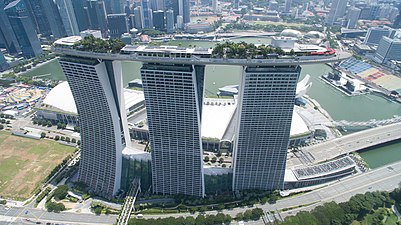
The Marina Bay Sands by Moshe Safdie Architects is a imposing structure, capped by its 340-meter long SkyPark connecting all three towers approximately 200 meters above the ground. The SkyPark seems to defy gravity with its 67-meter long cantilever past the north tower, yet this is representative of just one of many other fields of study that were essential to the successful conception, design, and construction of the building, in this case civil engineering.
Other fields of study include:
Mechanical Engineering: used in over 500 hydraulic jacks and four movement joints beneath the pools to keep them level as the buildings themselves move so that water flows evenly over the edge of the infinity pools.
Hotel Administration: the Marina Bay Sands is a hotel after all, so people with hotel administration degrees (or experience) were surely consulted to design the building so that it could be an effective, profitable hotel.
Urban Planning: the hotel is part of a much larger complex spanning 20 hectares, and thus urban planners were probably required by the city to evaluate how the proposal would interact with the rest of the urban community.
Environmental Engineering and Landscaping: to evaluate the environmental benefits of the gardens on the SkyPark, and to actually make them, respectively.
Materials Science: to discern the most appropriate materials for the building, or even engineer new ones.
Technical Drawing: to draw the precise specifications the builders would follow
Law: to make the contracts between the bidder for the site/owner of the building (Las Vegas Sands) and everyone else.
INVENT
A new capstone course necessary for architects to better serve the world is Affordable Architecture. This course consists of trips at the beginning of the term to impoverished communities living primarily in self-constructed shacks to study and critique the manners in which these dwelling are constructed. Throughout the rest of the term, students are then tasked with designing more architecturally influenced housing with similar budgets and materials as these dwellings–this is to say that they give the dwellings the actual function of being homely and welcoming rather than simply the use of shelter in order to improve the lives of the inhabitant and also destigmatize these communities. The principle is that the students should be able to achieve this function by using the materials more efficiently both structurally and artistically due to their education. It will also help bridge the gap between education in the “institute” (college) and through practice by giving the students firsthand experience in interacting with clients, working with physical and budgetary restrictions, and creating livable-scale buildings, all without needing an internship. Furthermore, this course does so on a relatively modest budget due to the nature of the homes, and perhaps most importantly creates more functional and useful homes for people who need them.
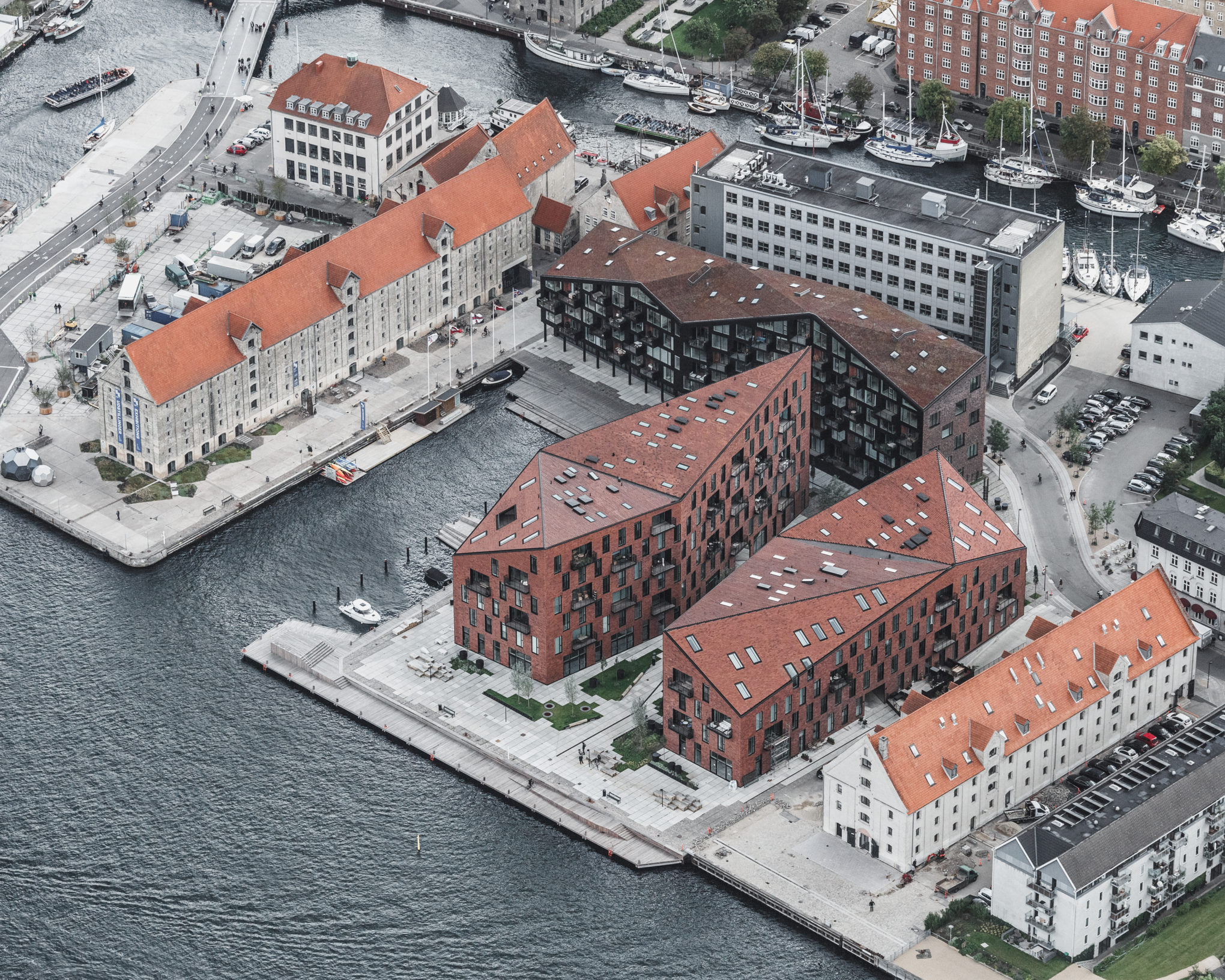
Krøyers Plads is Denmark’s first eco-labelled residential building complex. Krøyers Plads won the Green Good Design Award in 2017. It created a dialogue between old and new among the Copenhagen warehouses and uses materiality and form in a conscious way to create buildings that were sustainable and enhanced well being.
Fields of Study:
Architectural Drawing- Creating a familiarity in hand drawing in regards to proportions and angles
Digital Drawing- Drawing with digital devices for precision
Physics for Architects- understanding the physicalities and processes for buildings
Architectural Design- learning the forms and technical aspects of architecture in relationship with design
History of Architecture- understanding the architecture of the past to better create for the present/future
Environmental Systems- learning to enhance human well being in built environments through technology
Sustainable Building- Learning about sustainable materials and building processes that are starting to become more relevant
Invented Course: Designing for the Public
Implementing the knowledge from previous courses, redesign a public space/building and be as experimental in form and materiality as you want. This course is meant to push the student’s creativity while also being conscious of the issues that surround public space in relationship to people to people and people to built environment interactions.
An architects design has the ability to affect the mood, health, productivity, and behavior of people. In many design fields, it is helpful to have a target audience that is specific and niche. To design a public space will challenge the students to create a building/space that is not only functional, aesthetically interesting, and innovative, but a place for all people to feel welcome and safe. For example, hostile architecture is an intentional design strategy that often exists in public spaces and targets the homeless and youth and may be one aspect of public space for students to keep in mind while designing.
This course will be useful to the architectural education by pushing students to think for the general public instead of a specific client, it will most likely be an upper level course.
Bombay Sapphire Distillery in London – Thomas Heatherwick
DOCUMENT
Physics – the architect needs to understand the field of physics in order to construct a building that will stand and endure the weather conditions of that area.
Construction – although this field is necessary for the same reason as physics, in the case of this building, construction was more complicated because the glass structures rest on water. An architect needs to understand how to construct in different environments in order to work in a unique environment, especially because they need to be conscious of the dangers of using electricity near water.
Urban planning – an architect needs to understand how this building will relate to other buildings around it, and how it relates to the city.
Environment and sustainability – an architect needs to take into account how this building affects the health of the environment
Surface Structures – in this building, the surface is glass, and the glass bends in a very unique way. An architect needs to understand the flexibility of glass in order to make this building sustainable.
Biology – since this particular section of the building is a greenhouse, the architect must understand plant biology in order to construct a successful greenhouse.
Economics – since this building is a distillery that offers tours, the architect needs to keep in mind that one of the purposes of this building is to attract customers.
Psychology – like any building, an architect needs to understand how spaces have an effect on people’s emotions.
INVENT
My course that would be integrated into the curriculum of an architect would be titled “The Psychology of Drawings”. Because architecture students take studio classes every semester throughout their educational careers, they often forget how architectural plans appear to non-architects. Additionally, the drawings of plans and sections that students create lack the experience that a building conveys. This course will remind students of ways to communicate experience into their drawings by having each class meeting take place in a different building. Students will occasionally sit in typical classrooms, but they will also venture to museums, libraries, monuments and more. In addition to physically experiencing different types of buildings, students will experience buildings across the world via virtual reality sets. In a world where technology is rapidly advancing, I predict that in the near future, architects will no longer present their creations through three-dimensional models; rather, virtual reality projections of buildings will become the norm. Students will be challenged to discover the crucial differences between virtual reality and reality, and they will be tasked to create a virtual reality projection of one of their studio designs that creates the experience they seek.

 Brian's 212 Understanding Architecture Section